
Did Lil Tay Just Reveal She’s Older Than She Claims? The Internet Thinks So
When the clock struck midnight, social media star Lil Tay celebrated what she called her 18th birthday in true viral fashion—by launching a brand-new subscription platform. Within minutes, her account went live, and within hours, reports claimed she’d earned over $1 million.
:max_bytes(150000):strip_icc():focal(749x0:751x2)/lil-tay-1-080425-002f5ffec6e34800971e0e72f738498d.jpg)
It seemed like a perfectly timed marketing coup—until fans noticed something didn’t quite add up.
The Timeline Problem
According to OnlyFans’ verification rules, creators must already be 18 when they apply. The platform’s approval process includes facial-recognition scans, government-ID checks, and a manual review that usually takes 6–72 hours.
There’s no fast-track for fame. That means Lil Tay’s account couldn’t have been created, verified, and launched all within a single minute after midnight.
If the setup was completed earlier—and it almost certainly was—then Lil Tay must have already met the age requirement before her “birthday.” In other words, she wasn’t turning 18 that day at all. She was already at least 18 going on 19 or 20.
The Making of a Meme Icon
Born in Vancouver and reportedly arriving on July 29, 2007, Lil Tay’s online persona exploded when she was only nine. Her videos—full of swagger, luxury cars, and dollar bills—turned her into the self-proclaimed “youngest flexer of the century.”
Her rise was no accident. Behind the scenes, her older half-brother Jason Tian orchestrated the content—writing scripts, directing the delivery, and handling business outreach. Their mother, Angela Tian, a real-estate agent, even allowed filming inside the high-end homes she managed.
The family relocated to Los Angeles, chasing viral momentum. Soon, Lil Tay appeared in orchestrated online feuds with other internet personalities like Woah Vicky and Bhad Bhabie, sending her follower count soaring from a few hundred thousand to over 2.5 million in days.
But the success came with chaos—multiple managers, contract confusion, and constant media scrutiny. For a child still in elementary school, it was a whirlwind built entirely on performance.
Was Age Just Another Marketing Tool?
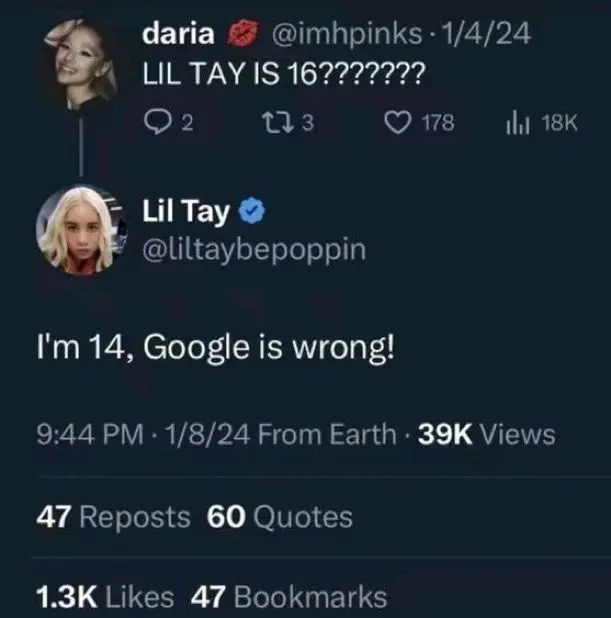
Public records list her birth year as 2007, making her 10 when she said she was nine. The age shift might seem trivial, but in online entertainment, youth sells. Portraying her as younger gave her brand an extra layer of shock value—one more year of being the “prodigy” everyone talked about.
This tactic isn’t new. Many entertainment figures have had their ages adjusted for branding purposes. For Lil Tay, the misrepresentation may have simply continued unchecked.
In January 2024, she even tweeted: “I’m 14, Google is wrong!”—which would make her 15 by mid-2024. Fast-forward to July 2025, and she’s claiming to turn 18? The arithmetic doesn’t match. Either her earlier statement was untrue—or her current birthday claim is.
Considering the verification process for her new account, the more plausible explanation is that she was already an adult well before the launch.
Why It Matters
Lil Tay’s story isn’t just about one influencer’s age; it’s about the blurred boundaries of internet fame. As a child, her persona was manufactured by adults. As an adult, her brand continues to hinge on calculated spectacle.
Her latest rollout, framed as an “18th-birthday” debut, appears to be less a celebration and more a strategic illusion—one that conveniently aligned with a marketing push. In doing so, she may have unintentionally confirmed that her public timeline has never been entirely real.
The question becomes larger than Lil Tay herself: Who controls the narrative? From child-star virality to carefully timed career pivots, her trajectory highlights how digital fame often prioritizes performance over truth.
Now, as she steps into a new, more mature chapter, the conversation shifts from curiosity to concern. If her persona has always been a product of external management, how much agency does she really have in shaping her own story?
The Bigger Picture
Lil Tay’s saga reveals how easily the lines between authenticity, marketing, and manipulation can blur in the influencer economy. What began as a preteen flaunting designer clothes has evolved into a case study of how youth, image, and profitability intertwine online.
Whether her “birthday” launch was clever branding or an unintentional slip, one thing’s clear: the internet’s youngest flexer has been playing an adult’s game for longer than anyone realized.